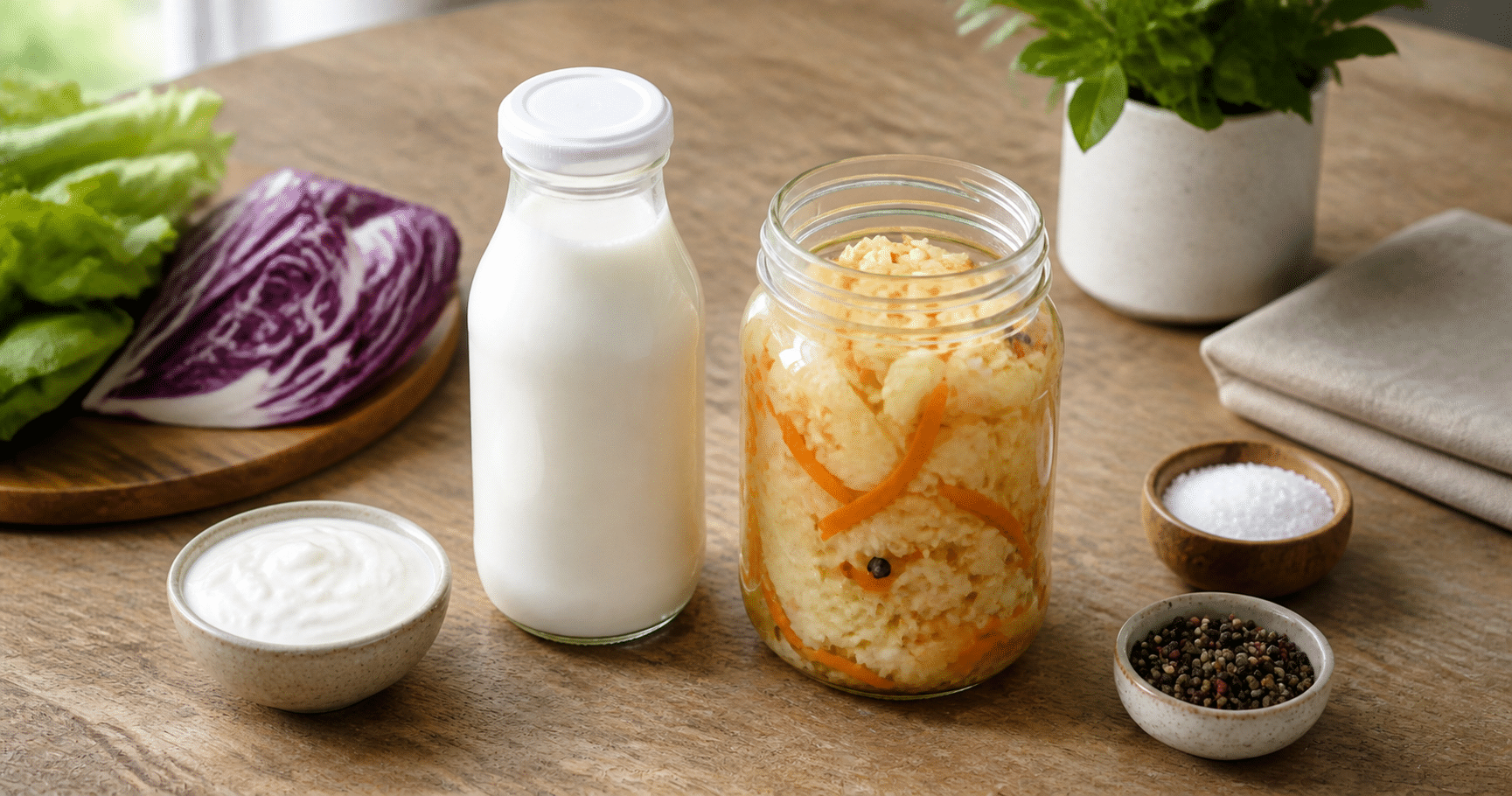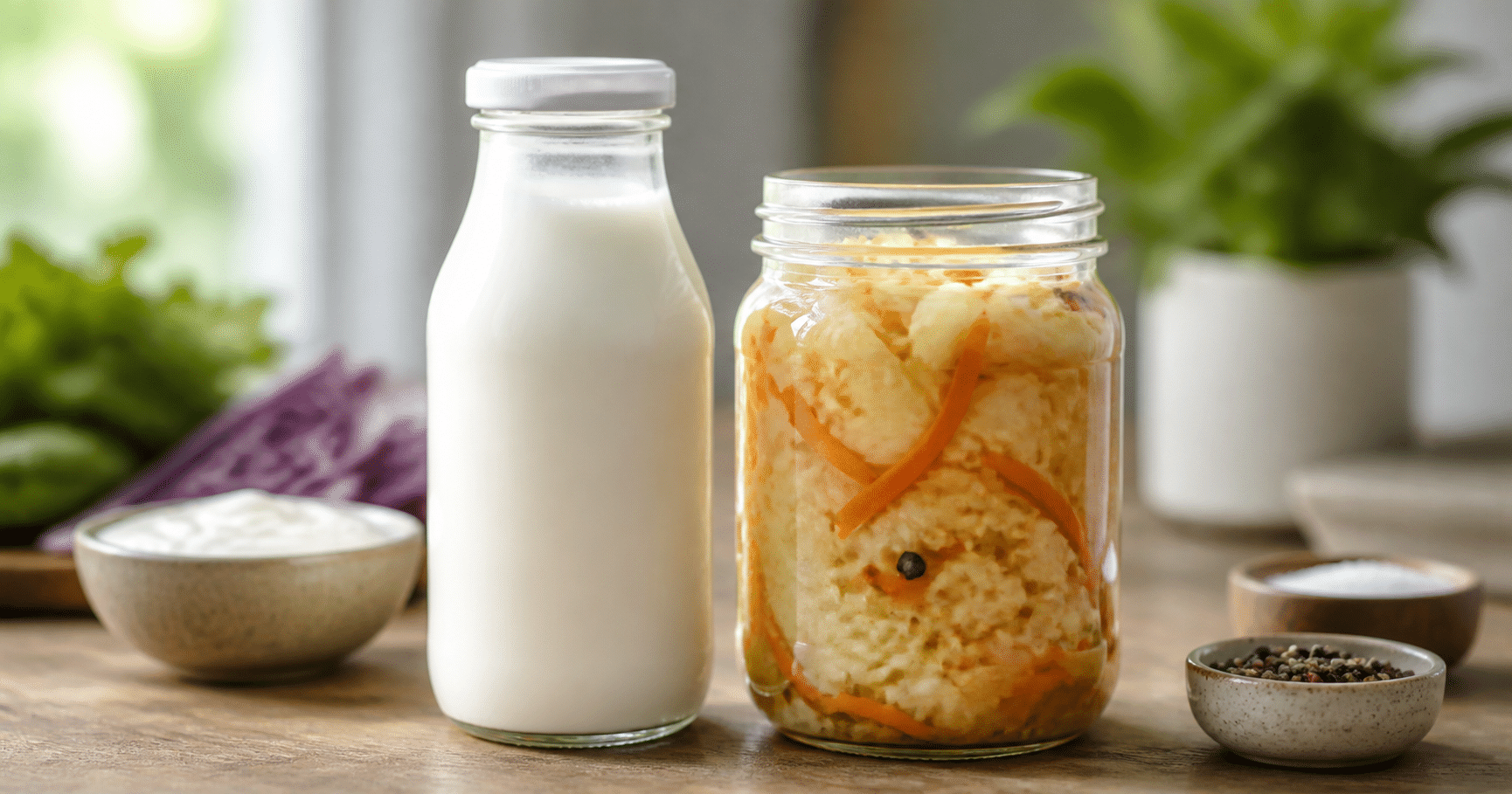
A bottle labeled “probiotic” and a jar of fermented vegetables may seem like two routes to the same gut-health goal. Both can involve microbes, but they are not interchangeable—and the word fermented does not automatically mean a food contains live probiotics.
The difference matters when you’re choosing kefir, kombucha, yogurt drinks, sauerkraut, kimchi, or other cultured foods. Some products contain living microorganisms; others have been heated or made in ways that leave few, if any, live cultures by the time they reach your table.
There’s another wrinkle: fermented foods may offer more than live bacteria. The fermentation process changes a food and produces compounds that remain even if the microbes don’t survive. Here’s what that means in practice, what labels can tell you, and how to fit both drinks and foods into everyday meals.
Probiotic Drinks and Fermented Foods: What’s the Difference?
A probiotic is a live microorganism that provides a health benefit when consumed in an adequate amount. That definition is more specific than “contains bacteria”: a product’s microbes, dose, and evidence for a particular benefit all matter. A drink can contain live cultures without proving that those cultures deliver a meaningful health effect.
Probiotic drinks include some kefirs, drinkable yogurts, and products with added bacterial strains. Kombucha is fermented too, but its microbes vary, and it should not automatically be treated as a clinically proven probiotic. Fermented foods include yogurt, kefir, kimchi, sauerkraut, miso, and tempeh—but processing and storage influence whether live cultures remain.
Fermentation can also create acids and other byproducts that change a food’s flavor and composition. Those compounds may still be present after microbes are no longer alive. So a fermented food can be worth eating without qualifying as a probiotic, and a probiotic drink isn’t necessarily more beneficial just because it comes in a bottle.
Three Differences Worth Checking Before You Buy
1. “Fermented” doesn’t guarantee live cultures
Some fermented foods are pasteurized or cooked after fermentation, which can kill live microbes. Shelf-stable sauerkraut, for example, may have been heat-treated, while refrigerated versions may retain live cultures—though the label is the best guide. Pickles made with vinegar are generally not fermented in the same way as naturally brined pickles.
Heat matters at home, too. Stirring live-culture yogurt into a hot soup may leave the food’s flavor and nutrients intact, but it can reduce the number of living microbes. If live cultures are the point, add cultured foods after cooking, once a dish has cooled.
2. Drinks can be convenient, but the contents vary
A small bottle is easy to portion, and some drinks list specific microorganisms on the label. Look for the names of the strains and, when provided, a guarantee that the listed amount is present through the end of the product’s shelf life. A larger number of colony-forming units (CFUs) is not automatically better; the relevant amount depends on the product and the evidence for that strain.
Check the rest of the label, too. Sweetened drinks can add a surprising amount of sugar, and some kombuchas contain caffeine or a small amount of alcohol from fermentation. Plain kefir or unsweetened drinkable yogurt may be a better fit if you want to limit added sugar.
3. The research doesn’t make every product equivalent
Studies of probiotics are often specific to a strain, dose, and health outcome. Findings about one studied strain cannot automatically be applied to every drink or fermented food. Research on fermented-food-rich diets is also promising but does not prove that any single product will improve everyone’s gut health.
For most people, these foods are best viewed as options within a varied diet—not as guaranteed treatments. Fiber-rich foods such as beans, vegetables, fruit, and whole grains also help support the gut’s microbial community by providing nourishment for beneficial microbes.
A Practical Way to Try a Drink and a Fermented Food
You don’t need a special schedule or a large serving to compare them. Start with familiar foods, use the package’s serving guidance, and notice how each fits your taste, digestion, budget, and routine.
Step-by-Step Instructions
-
- Choose one drink. Try plain kefir or drinkable yogurt, or select a probiotic beverage that names its cultures. Check added sugar and storage instructions.
-
- Choose one fermented food. Options include refrigerated sauerkraut or kimchi, yogurt, or miso. If live cultures matter to you, look for label language such as “contains live and active cultures”; not every product makes the same claim.
-
- Start with ordinary food portions. Pour a serving of the drink according to its label. Use a spoonful or two of a salty fermented vegetable as a condiment rather than treating it as a main dish.
-
- Keep the rest of the meal balanced. Pair these foods with a meal that includes fiber, such as beans, whole grains, or vegetables. This offers a broader range of nutrients than relying on a drink alone.
-
- Store products as directed. Refrigerate items that require it, use them by the date on the package, and don’t assume a product stays rich in live cultures if it has been left warm or improperly stored.
If you’re sensitive to dairy, choose a suitable non-dairy product and check its label; not every plant-based drink contains live cultures. People with a severely weakened immune system should ask a health professional whether live-culture products are appropriate for them.
Let the Label—and Your Meal—Set Expectations
Probiotic drinks and fermented foods can overlap, but they don’t work in exactly the same way. A drink may deliver named live strains; a fermented food may provide live microbes, fermentation byproducts, or both. Processing, storage, ingredients, and the specific cultures all shape what you’re getting.
Choose products you enjoy and can fit into a varied diet. The most useful label is not the one with the biggest probiotic number; it’s the one that tells you what’s in the food and how it was made.