
If you are buying sauerkraut off the shelf to help your gut, you might be wasting your money.
While sauerkraut is technically a fermented food, most commercially available brands found in the center aisles of the grocery store have been pasteurized. This means they were heated to high temperatures for shelf stability. While this preserves the texture, it kills the beneficial bacteria (probiotics) that you are trying to consume.
The solution? Make it yourself.
Homemade “lacto-fermented” sauerkraut is one of the most potent probiotic supplements you can take. It contains trillions of colony-forming units (CFUs) of bacteria – often far more than an expensive probiotic pill—and it costs pennies to make.
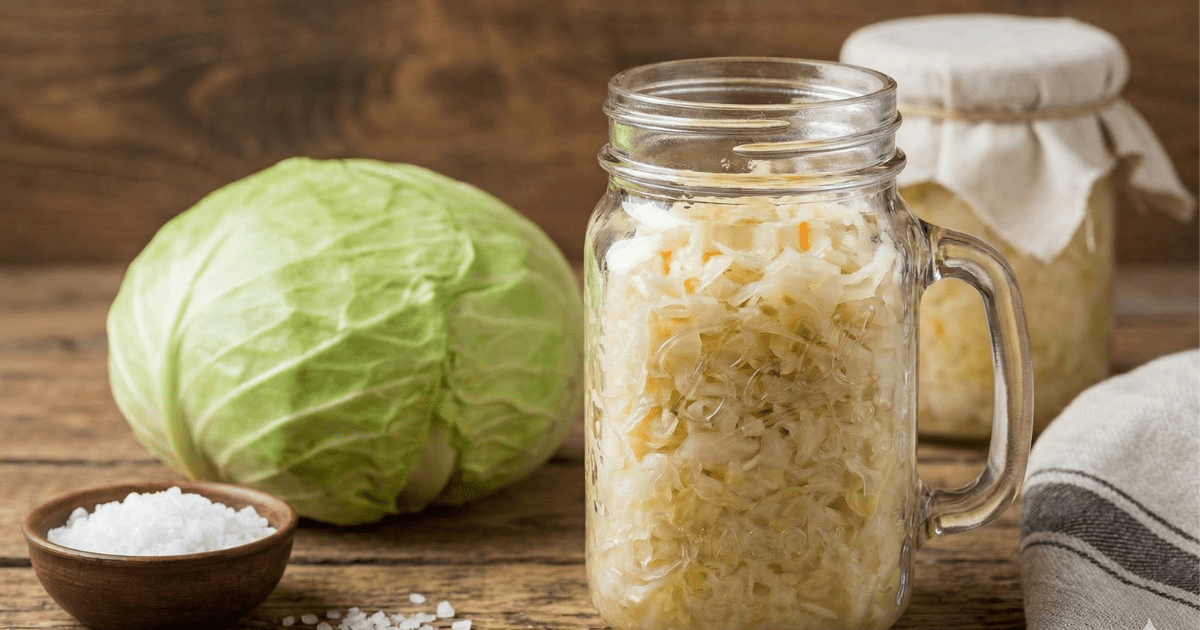
Best of all, you don’t need a crock or fancy equipment. You just need a mason jar and one humble head of cabbage.
The Science: What is Lacto-Fermentation?
It sounds complex, but it’s nature’s simplest preservation method.
All vegetables, including cabbage, naturally have beneficial bacteria (Lactobacillus) living on their surface. When you submerge cabbage in a salty brine and deprive it of oxygen, bad bacteria die, but the Lactobacillus thrive. They convert the natural sugars in the cabbage into lactic acid.
This lactic acid is what preserves the cabbage, gives it that signature tangy sourness, and creates a gut-healing superfood.
The Mason Jar Method: A Step-by-Step Guide
This recipe creates a “small batch” (about 1 quart), perfect for beginners.
Ingredients:
-
1 medium Head of Green Cabbage (about 2 lbs)
-
1.5 tablespoons Sea Salt (Do not use iodized table salt; iodine inhibits fermentation!)
-
1 tbsp Caraway Seeds (Optional, for traditional flavor)
Equipment:
-
1 wide-mouth Mason Jar (Quart size)
-
A smaller jar or glass weight (to weigh the cabbage down)
-
Cloth or coffee filter and a rubber band
Instructions:
1. Shred: Remove the outer leaves of the cabbage (save one large leaf for later). Core the cabbage and slice it into thin ribbons using a sharp knife.
2. Massage: Place the shredded cabbage in a large bowl and sprinkle the salt over it. This is the most important step: Massage the salt into the cabbage with your hands for 5–10 minutes. You are manually breaking down the cell walls. The cabbage will release a significant amount of water. This liquid is your “brine.”
3. Pack: Transfer the cabbage and all the liquid brine into your mason jar. Pack it down tightly with your fist or a wooden spoon to eliminate air pockets.
4. Submerge: The cabbage must be completely submerged under the brine to prevent mold.
-
Tip: Fold the large outer leaf you saved earlier and press it on top of the shredded cabbage like a “lid.”
-
Weight it down: Place a fermentation weight or a smaller jelly jar filled with water on top of the leaf to keep everything pushed under the liquid.
5. Ferment: Cover the jar with a cloth or coffee filter secured with a rubber band (this keeps bugs out but lets gases escape). Place the jar in a cool, dark corner of your kitchen (out of direct sunlight).
6. Wait: Let it ferment for 3 to 10 days.
-
Day 3: Start tasting it. It should taste slightly sour.
-
Day 7-10: It should be tangy, crunchy, and delicious.
Once it tastes right to you, screw on a tight lid and move it to the refrigerator. The cold stops the fermentation. It will keep for months!
Troubleshooting: Is That Mold?
-
White Scum: If you see a thin, white, powdery film on top, that is likely “Kahm yeast.” It is harmless but can taste bad. Scrape it off.
-
Fuzzy Spots: If you see fuzzy green, black, or pink spots, that is mold. Discard the batch and start over. (Mold usually happens if the cabbage wasn’t fully submerged under the brine).
Medical Disclaimer
This article is for informational purposes only. Fermented foods are rich in histamine and may not be suitable for those with histamine intolerance or SIBO. Consult your doctor before making significant dietary changes.