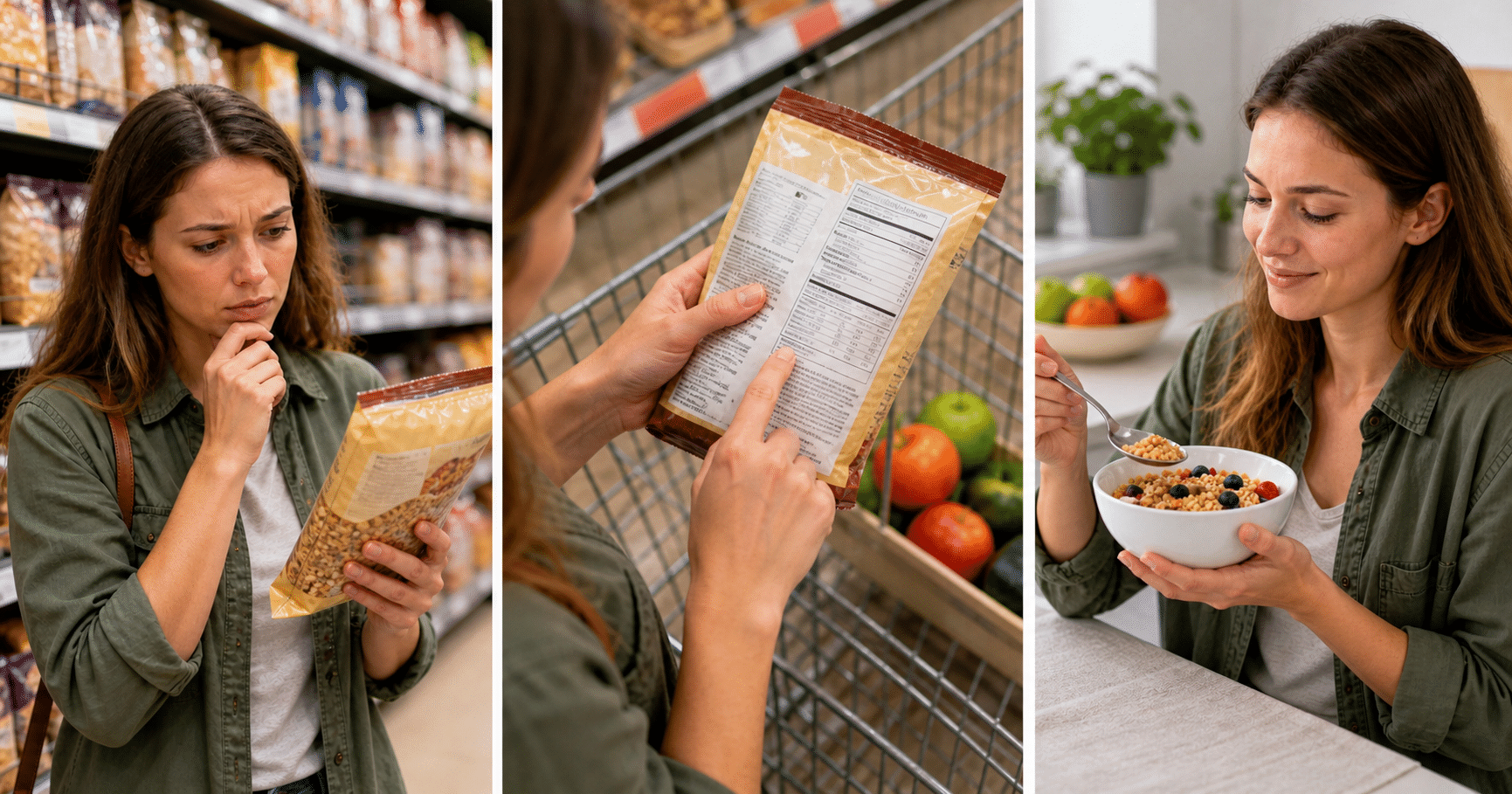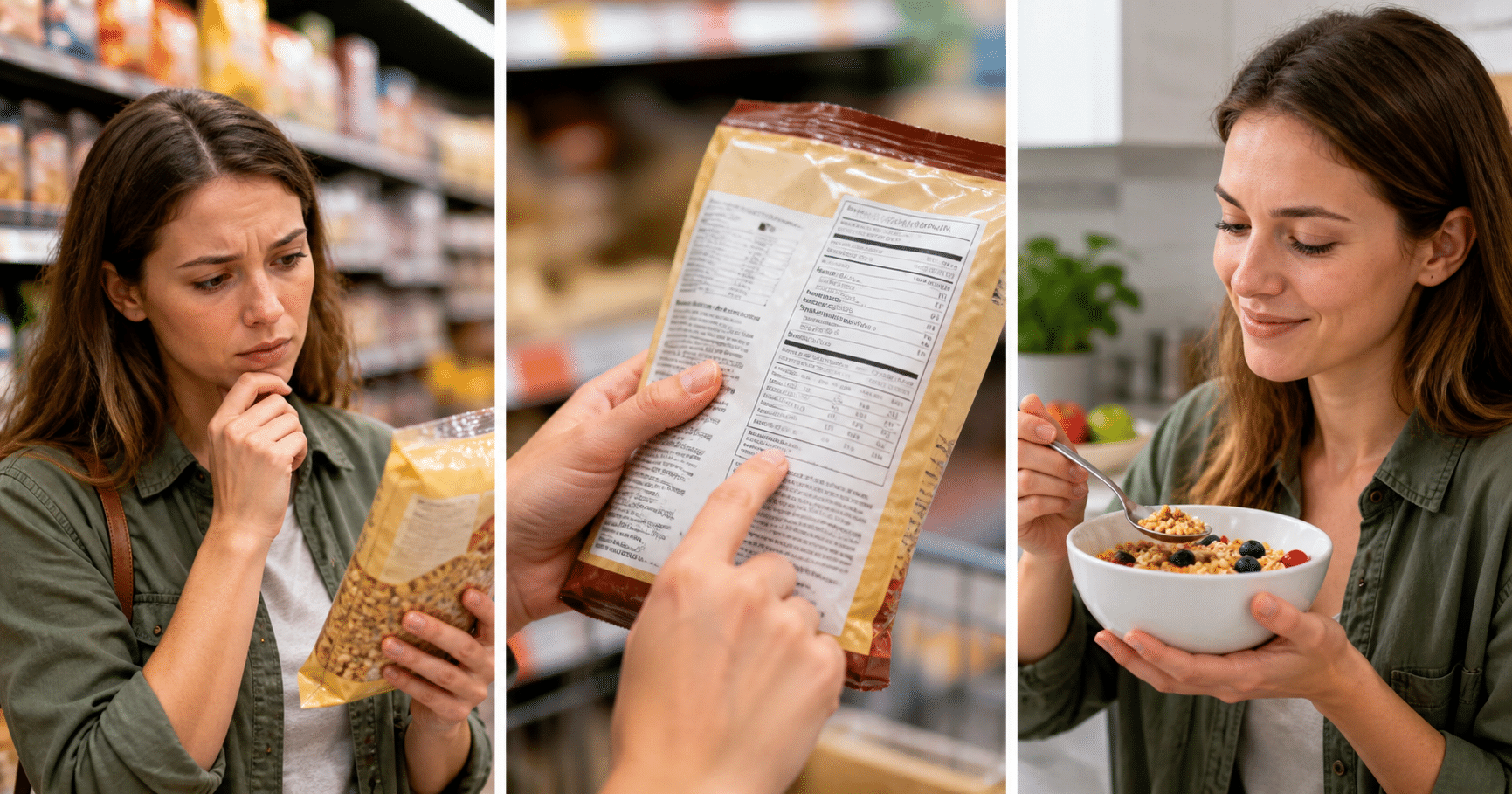
A package can say “made with whole grains,” “light,” or “natural” in large letters while the ingredient list tells a more complicated story. The front is designed to help sell the food; the list on the back is where you can see what went into it.
That doesn’t mean a long ingredient list is automatically a warning sign, or that an unfamiliar name is harmful. It means the words need context: ingredients appear in a particular order, marketing terms have limits, and a product can sound healthier than it is.
With a few simple habits, you can read labels more confidently—whether you’re choosing bread, cereal, soup, yogurt, or a snack. Here’s how to look past the packaging and focus on what the food actually contains.
Start With the Ingredient List, Not the Front of the Package
In the United States, ingredients are generally listed in descending order by weight. The first ingredient makes up more of the product than the ingredients that follow, though the list doesn’t tell you the exact amount. Ingredients present at less than 2% may be grouped at the end after wording such as “contains 2% or less.”
That order can be revealing. If sugar, syrup, or refined flour appears near the top of a breakfast cereal or snack, it is a substantial part of the recipe. If a product’s name highlights oats or fruit, check whether those ingredients appear prominently—or much farther down the list.
Some ingredients are listed as components of another ingredient. For example, a flavored coating might be followed by a parenthetical list of its own ingredients. Read those too: the details can explain where added sugars, oils, or other components are coming from.
Five Label Clues That Put Marketing in Perspective
1. “Natural” doesn’t mean minimally processed or more nutritious
For most foods, the FDA’s longstanding policy on “natural” focuses on whether anything artificial or synthetic has been added that would not normally be expected in the food. The term does not tell you that a product is low in sugar or sodium, minimally processed, organic, or especially nutritious.
Use the ingredient list and Nutrition Facts panel to answer those questions. A “natural” claim is not a substitute for checking what you’re buying.
2. “Multigrain” and “made with whole grains” need a closer look
“Multigrain” means a product contains more than one type of grain; it does not necessarily mean those grains are whole. “Made with whole grains” also doesn’t tell you how much whole grain is in each serving.
Look for a whole grain—such as whole wheat, oats, or brown rice—near the beginning of the ingredient list. “Whole wheat flour” is different from “wheat flour,” which generally refers to refined flour. A brown color or seed-covered crust isn’t proof that bread is whole grain.
3. Sugar has many names—and more than one source
Added sugar can appear as sugar, cane sugar, honey, molasses, corn syrup, or ingredients ending in “-ose,” among other names. The list groups all ingredients by weight, not by category, so different sweeteners may appear separately rather than together as one “sugar” ingredient.
Check the Nutrition Facts panel for Added Sugars, listed in grams and as a percentage of the Daily Value. Total sugars also include naturally occurring sugars, such as lactose in plain milk or sugars in fruit. “No added sugar” does not mean sugar-free.
4. “Reduced” or “light” is a comparison, not a clean bill of health
A “reduced sodium” or “reduced sugar” claim generally means the product has at least 25% less of that nutrient than an appropriate reference food. It may still contain a considerable amount. “Light” can refer to different characteristics, such as calories, fat, or color, so check the package and compare the numbers.
Serving size matters here. If one package contains two servings and you eat the whole thing, you may be getting twice the listed calories, sodium, or added sugars.
5. An unfamiliar ingredient name isn’t automatically a red flag
Food ingredients can have technical names because they perform a practical job, such as keeping a product stable, thickening it, or preventing spoilage. A long list may reflect a complex recipe rather than a simple measure of nutritional quality.
Instead of judging by length or pronunciation, ask what matters for your needs: How much added sugar or sodium is there? Does it contain an ingredient you avoid? Is the food a useful source of fiber or protein?
A Quick, Reliable Way to Compare Two Foods
At the store, compare similar products in this order. This keeps a bold front-of-package claim from becoming the only thing you notice.
-
- Check the serving size. Make sure the amounts you compare are based on the same serving, and consider how much you typically eat.
-
- Look at the nutrients that matter to you. Compare added sugars, sodium, fiber, saturated fat, or protein as relevant. The Daily Value can help: 5% or less is generally considered low, while 20% or more is generally considered high for a nutrient per serving.
-
- Scan the first few ingredients. They make up the greatest share by weight. Look for the foods or ingredients you expect to be central to the product.
-
- Check the rest of the list for your priorities. Look for allergens, sweeteners, oils, or other ingredients you prefer to limit or avoid.
-
- Compare the products as a whole. A shorter ingredient list is not automatically better, and one nutrient number rarely tells the entire story.
For instance, when comparing two jars of pasta sauce, serving size and sodium can be useful starting points. Then check whether tomatoes are prominent and whether added sugar is listed. The goal isn’t to find a mythical perfect label; it’s to choose the option that fits your preferences and meals.
Allergen Statements Deserve a Separate Look
If you have a food allergy, don’t rely on front-of-package claims or memory of a brand’s recipe. U.S. labels must identify major food allergens, including milk, eggs, fish, shellfish, tree nuts, peanuts, wheat, soybeans, and sesame. They may appear in the ingredient list or in a separate “Contains” statement.
“May contain” statements are generally voluntary, so their presence—or absence—does not replace careful label reading. If you have an allergy, follow guidance from your health care professional about managing exposure.
Read the Fine Print, Keep the Big Picture
The ingredient list is most useful when you pair it with serving size and the Nutrition Facts panel. Front-of-package language can offer a clue, but it rarely tells the whole story.
Next time a claim catches your eye, turn the package around before deciding. A few seconds of label reading can turn “sounds healthy” into a choice you understand.